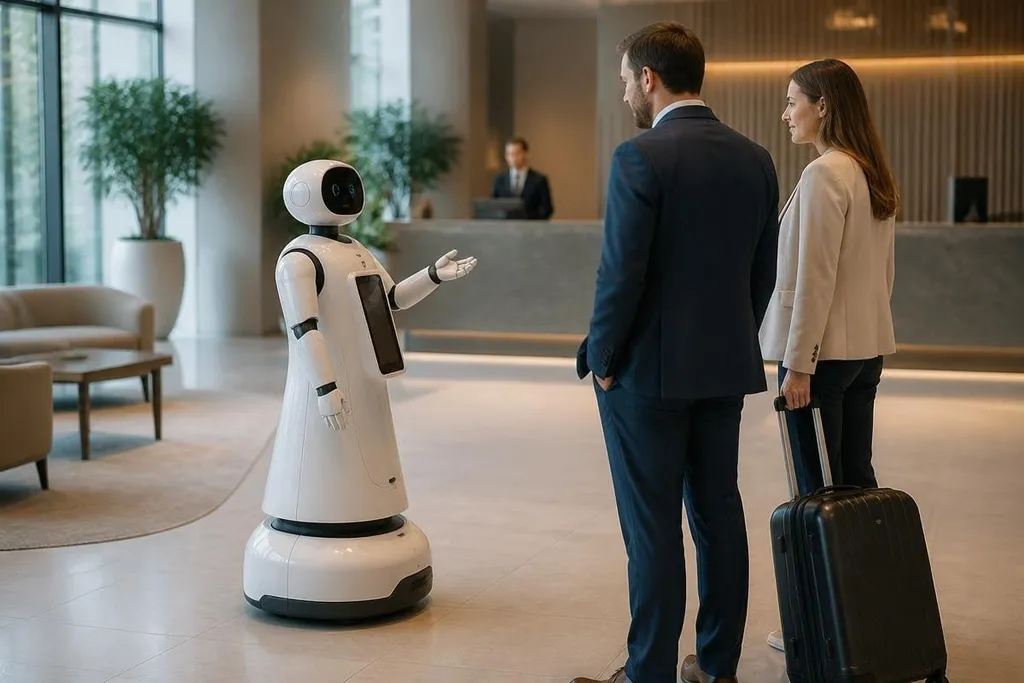
A social robot can greet visitors, guide people through a building, teach a lesson, or help with routine care tasks. The business question comes before the hardware question: who pays for that work, and what does the robot do when a person gives an unclear answer?
- Best opening: guided service work with repeatable steps
- Main cost: staff time, maintenance, privacy controls, and site changes
- Unproven area: long-term value after the first public demo
Where a buyer can charge for the work
The clearest opening sits in places where people repeat the same interaction many times. A robot in a hotel could answer common questions, point guests toward a room, or call a staff member when the request falls outside its script.
A hospital could use one to guide visitors through a lobby, provided the site can keep private conversations away from its microphones.
Education offers a different path. In a classroom, the robot could lead a language exercise, ask pupils to repeat a phrase, or give a teacher a record of completed practice. The school still needs a teacher, so the sale depends on whether the robot cuts routine work without adding setup and repair work.
Care settings may offer paid work through reminders, check-ins, and simple activities. The limits matter more here. A robot that misses a medication question or misreads distress needs a clear handoff to a person, not a polite answer from a speech model.
Retail, museums, and public buildings can also buy guided interactions. These sites may care less about a robot's human-like face than its ability to answer a fixed set of questions, work for a full opening period, and send hard cases to staff.
The business model is wider than the robot
The first sale may be the smallest part of the business. A supplier could charge for installation, site mapping, software updates, remote help, replacement parts, and staff training. Each item answers a real cost that appears after the robot leaves the showroom.
The system also needs a way to connect with existing systems. That might mean a booking tool, a school record system, a queue display, or a call system. Buyers should ask whether the robot uses a documented application programming interface, or API, so another supplier can work on the connection later.
Remote assistance can make a service workable when the robot reaches a request it can't handle. The operator should see only the data needed for that task, and the contract should state who pays when a person must step in.
For a founder pricing a social robot service, robotics coverage from Robot24.com can place a company’s plan beside its machine and test setting before trust becomes the next test.
The hard part is trust
A social robot records speech, images, movement, or all three, depending on its sensors. That creates a business task around consent, storage, deletion, access, and local rules. A buyer needs plain answers before a robot enters a school, care home, shop, or public lobby.
Failure handling matters just as much. The robot should show when it has not understood, stop when a person asks, and call a named staff member when the task leaves its approved limits. A smooth conversation means little if staff can't tell what the robot heard or why it acted.
The supplier also needs to state what the robot can do without a network connection. If speech or vision stops when the link drops, the site needs a safe fallback. That may be a fixed screen, a call button, or a staff member taking over.
I’d back narrow service jobs before open-ended companionship, because a buyer can count the work and check the failure cases.
A buyer's decision check
Use this list before paying for a pilot:
- Name the task: write the exact interaction the robot will handle and the point where staff take over.
- Count staff time: include setup, charging, cleaning, repairs, remote help, and daily checks.
- Set privacy rules: record what sensors collect, where it stays, who can see it, and when it is deleted.
- Test failure cases: use unclear speech, a blocked route, a lost network link, and a request outside the script.
- Check the exit: ask how the site can export its data and remove the robot without losing access to other systems.
A useful pilot should measure completed interactions, staff handoffs, downtime, and the cost of each successful task. If those figures aren't tracked, the project may produce a pleasant demo without showing a business case.
The next paid social robots will likely earn their place through one repeatable task, a clear handoff, and a contract that names the costs after installation.